THE SANTA CRUZ TREK
As documented by the students of Travel Journalism
Day 0: “Before the Adventure Could Even Start” – Scout, senior, Connecticut
Preparation for the Santa Cruz trek ensued with a flurry of packing lists,
trips to the gear store, emptying out the fridge, and lessons on everything
from reading topo maps to using the bathroom in the great outdoors. In the days
before leaving, girls dug out layers they hadn't seen since Miami, organized
group food, took their final showers, and got ready to hit the trail.
On March 29
th, two days before leaving for the trek, we set off
early for an acclimatization hike in the Cordillera Negra. Running alongside
the Cordillera Blanca, home to the Santa Cruz trek, the Cordillera
Negra is its less snowy counterpart, and from there we could see the white
peaks we would be heading to the following day. While our acclimatization hike included a steady descent over the rocky trail leading back into the valley, it
was filled with frequent stops occupied with everything from snacking to posing
for pictures before the surreal mountain views. On one of our earliest breaks,
Erin gave us a thorough lesson on “Leave No Trace” trail ethics, complete with
demonstrations of switchbacks and packing out trash, and later on we spent a
silent lunch reflecting on both the vast landscape and little miracles that
surround us in nature.
Arriving back to our hostel three hours earlier than planned, tired and
sunburned, the afternoon consisted of trips to the gear store to replace missing
socks or moldy water bottles, and a briefing on where the next six days of
walking would take us. It also happened to be Susannah's birthday the day after we celebrated Allie's birthday. Born from Erin's “Leave No Trace” lesson, the evening concluded with a
“Leave No Trace” themed birthday bash. During the festivities, Susannah was led
by Tour Guide Allie through a maze of trail ethic skits ranging from the LNT
police patrolling for people leaving trash, to a herd of sweat-hungry cows and
rabid dogs that she was diligently warned to stay away from. On the roof of the
hostel, surrounded by the sounds of nighttime Huaraz and the glow of distant Peruvian
stars, we shared our favorite "Susannah moments" and celebrated with ice cream, cookies and togetherness.
The next morning came with eggs, bacon, and optional PE or church. After a
few hours of classes, we divided up to tackle group gear packing. With one
group on dinner, one on breakfast and lunch, another on GORP and the last on
group gear, the hostel kitchen was littered with wrappers and bulk packaging as
we condensed, double bagged and piled up oatmeal, ramen, hot chocolate, and
anything else dried, sustaining, and purchasable in large amounts. Following
this organizational feat, our teachers presented us with the “sexy pack”
demonstration – how to strap everything down, what should be accessible, what
needs to stay dry, and where rain gear should go. Packing itself, after
numerous lists and check-ins, was an affair of scattered gear, trashbags, prioritizing
and running from room to room in search of shared and reclaimed clothing. When
the cloud of bandanas, Smartwools, wet wipes, and poly-pro cleared, there were
23 neatly packed backpacks, one on each bed, and 23 trashbags of unneeded
clothes and gear tucked away in storage. After a final study hall at Cafe Andino
next door, it was early to bed in preparation for the next few days, boots
lined neatly by the door, and eagerly awaiting our transport into the
mountains the next morning.
Day 1: “Why Are We Backpacking?” – by Courtney, senior, New Jersey
My alarm beeped and screeched, flashing 6:00am in my face. I rolled out of
bed, grabbed my orange Tupperware and walked to breakfast. In order to clear
out our food supply, we had every type of yogurt and leftover birthday cake for
the most important meal of the day. After packing our PB&J lunches, we headed
out of the hostel and filed into our white “turistico” vans. We kissed Huaraz
goodbye.
We sat in the vans for hours, driving on the edges of cliffs and looking our
at the mountains that poked into the clouds. The ride ended as we arrived in
the tiny village of Cashapampa. Two men stood smiling with donkeys. We were
quickly introduced to our arrieros, Pedro and Luis. After a short introduction
from all the TTS girls, Pedro went on to say that we were all his family
throughout the trek.
With our hiking boots laced up and our big packs strapped on, we played a
game of “Wah” as our teachers talked to Pedro and Luis. As Heather made her
final announcement, telling us to have empty bladders and full water bottles, I
felt a wave of anxiety, fear, and excitement wash over me. We began to march
out, clutching our purified water bottles as we looked up at the trail we were
about to conquer.
We began to talk on a rocky trail, crossing over a rushing river, the more
we walked, the more steep and dry our trail became. As we continued uphill, I
began to wonder why we were doing something so painful, as the sun blazed on
our faces. I thought to myself, “I am not meant for backpacking.” The girls in
front of me stopped, announcing that it was break-time. My legs collapsed and I
dropped onto my backpack. I took a moment to look around and was overcome by
the scenery that we had worked our way into. A waterfall flowed next to me and
surrounding us were mountains that didn't look quite so tall from our height.
There are some places that can't be reached by a vehicle.
As our trail began to flatten out and we crossed a stream, I could see Pedro
and Luis waiting for us at our campsite. A waterfall marked our home for the
night, and I dropped my bag, grateful the hike was over. Later, as I looked up at
millions of bright stars, I thought, “THIS is why people backpack.”
Day 2: “Pacha Ichicocha” – by Charlotte, sophomore, Virginia
After a steep and strenuous initial day of backpacking, our campsite, ringed
with mountains and waterfalls, stayed quiet until groggy but cheerful faces
unzipped their tents at half past seven. We gathered for out rations of oatmeal
before sending off three members of the group. Heather P, Vickie, and Hannah
began their descent back to Cashapampa for health reasons, but only after
rounds of hugs and safe wishes. Between redistributing the dwindling group
food, filling water bottles in the Santa Cruz River, folding up tents, and
organizing our bags, we were not prepared to leave until ten.
Starting at an elevation of 3700 meters, we only climbed 100 meters over the
next four and a half miles. The terrain's gentle slopes and flat stretches came
as a relief. The majority of the path remained level, yet littered with rocks
and squishy with sand. We crossed over the Santa Cruz River multiple times as
the trail wandered. Whether with animated skips, tentative stepping stones, or
splashing strides, we kept on the elusive path past Llamacorral. We broke for
lunch on the side of the trail. Packs plummeted to the ground as we eagerly
shed the unfamiliar weight.
We hiked through Sapichuayta, maintaining a pace that supported the spectrum
of speeds in the group. Conversations ranging from discussions of our parents
to memories of previous backpacking trips entertained us for the five hours of
walking. Pedro, our lead arriero, waited for us just around a bend in the
trail, standing on a large rock. His greetings signaled the conclusion of the
day's trek. Anew with energy, we explored our temporary home.
Our campsite lay at the edge of Lake Ichicocha. Rocks from the size of mere
pebbles to mighty boulders sprinkled the even field. Mountains loomed on two
sides while light tunneled through the channel they formed. We set up tents in
the sunshine, nudging stray cows off our ground tarps.
History class ensued with the final few presentations of South American
leaders, in an outdoor environment highlighted by a double rainbow arching as the
backdrop. Cook crew prepared a hearty supper over a two-burner gas stove. We
all ate in a circle, swelling the communal tent with our physical presence as
well as laughs and voices. Voices rehashing the voyage so far, and speculating
what was to come, scattered in the night air before returning to our sleeping
bags to slumber.
Day 3: “Hiking Over the Hump” – by Allie, sophomore, Montana
Beep, beep, beep. Hearing my alarm, I rolled over in my sleeping bag, not
wanting to go out into the much colder mountain world. Slowly, I , along with my two
tent-mates Kate B and Alizah , extracted ourselves from our
sleeping bags, put our warm clothes on, grabbed our Tupperware and emerged from
our tent into the waking world. Immediately, I was again hit with the
beauty of our campsite and the Cordillera Blanca. Already our third day on the Santa Cruz trek, and I
knew I would never become accustomed to the view. Mountains shot up on all
sides, their peaks hidden in the wispy clouds that hung ominously
above. Waterfalls, disguised in the mountain rocks, sprung forth in a
whitewater shower. The green grass flattened beneath my
feet as I walked across camp to our breakfast tent.
A campsite like this is a pretty great place to have a birthday, one might
say, and lucky for Caroline, now 17, her birthday happened to be today,
April 2. The morning silence was broken by “happy birthdays” and
“can you believe you're 17?!” The excitement of another TTS birthday hung in
the air as we ate our breakfast of oatmeal and polenta patties. After
breakfast, everyone dispersed to prepare for the hike from Ichicocha to Taullipampa. This included deflating sleep pads,
packing our clothes and sleeping bags, dismantling our tents, taking a pile of
group gear that everyone helped carry, putting the final touches on our packs,
and meeting at 9:15 in a circle at a central location ready to go. For the next
15 minutes, we stretched our sore muscles and talked about the day ahead of us.
Hiking for five to six hours, gaining 1100 feet and ending up at “the most
beautiful campsite in the world” was just the beginning of it.

Within the first ten minutes of our hike, we passed by a stunning blue
glacial lake, set in a frame of towering mountains that met in a “V”behind it.
“BAM!” rang out through the group as we all stopped for a Beauty Appreciation
Moment. We had been hiking in this valley for a couple of days now, but this
was the first glacial lake we had seen. We continued hiking for a couple hours,
taking breaks here and there, until the scenery suddenly changed. Before we
were hiking in forest-like areas with the Santa Cruz River running alongside,
but all of a sudden, we were walking along vegetation-free, trail-free open
land. Multiple creeks ran through the floor of sand, interfering with the
desert-like scenery. We walked across this land for awhile, ate lunch there,
and prepared for the switchbacks we saw cut in the mountain straight ahead of
us. We stared the uphill as the weather decided to rain. Frantically getting
out rain pants, coats, and backpack covers, we kept on hiking, prepared for
anything. After a few hours, we were all gasping for air, feeling our backs
and legs, when we saw it, “the most beautiful campsite in the world.” Not one,
not two, but three glaciers towered over us and behind us was the valley we had conquered. Accomplishment filled the air with the
knowledge we were now halfway done.
After setting up tents and laying out any group gear in our possession, we
had a little free time until dinner. While eating a warming ramen noodle dinner, we partook in the TTS
birthday tradition of going around in a circle and saying one thing we love
about the birthday girl. As each person went, the dome-like tent filled with
the love, support, and joy that was obvious in the words that were spoken then
and throughout the day. Snuggling into our sleeping bags after dinner, sleep
hit fast and hard as we prepared for another day - up to the pass.
Day 4 – by Rebecca, junior, Montana

“Zip, zip, zip,” I opened the tent door to reveal one of the most beautiful
campsites in the world. Surrounded by three mist-covered glaciers and towering
mountain peaks, my eyes swirled in astonishment of the morning view. After
eating an assortment of oatmeal in our Tupperware containers, we packed our
tents, gear and bags as the nerves began to grow. The collective group was feeling the
weight today would hold, not only on our backs, but also in the steep uphill slopes
to come. Although we were reminded that in times of hardship, the power of
one's mind can shift an experience for the better or worse. Shouting “we are
TTS”and the consistent encouragement that “we can do this” began our trekking
off to a positive vibe. With two liters of water, snack bags full and rain
jackets on, the twenty of us began our climb to the pass. To help speed up the
time, we had conversations ranging from glacial lakes to boys. We stopped at
the curve in a switchback and stood breathless (physically and literally) of
the view. In that same instant, a condor flew over the pristine blue water and
circled around the valley, displaying its immense wingspan. Our arriero, Luis,
told us the condor is an Andean sign of good luck and fortune. With our spirits
lifted and the “red wooden marker” in sight, we forged forward. The last 210
steps to the Punta Union pass seemed to be the most pivotal steps I have taken.
Cheers, high fives, and hugs were exchanged as our group felt a sense of unity
reaching the pass. We took photos next to the sign depicting that were 14,250
feet high in altitude. While enjoying the lunch break, we indulged in (Snickers like) chocolate
bars that Heather F. used to symbolize and describe as the layers of glaciers. One the downhill section of our
hike, some of us slid and slipped on the rocks and mud, but you would always
look from your fall to see a hand waiting to help you up. The feeling of
accomplishment grew as our campsite was within eye sight. We marched through
the rain and happily arrive at our site. Setting up tents, cooking quinoa and
pasta while snuggling together in sleeping bags concluded day four of the Santa
Cruz trek.
Day 5: “Dia de Relief” – by Feyza, junior, Iowa
On day five of the Santa Cruz trek, we crawled out of damp tents looking out
to the pass we had summited the day before. The feelings of accomplishment and
joy from it still lingering. The mountains with icy glaciers and jet black rock
provided a dramatic contrast to the green-brown grass and moss lichen covered
rocks surrounding our campsite, Morococha. We drowsily ate our oatmeal in the
yellow dome tent preparing for the six hour downhill hike to come.
After packing up a bit faster than the previous day, we gathered in a circle
for group stretches and to talk about how important it is to be careful hiking
downhill. We set off around 9:30, talking and laughing, as we scampered over
rocks and trudged through mud. The path that day was quite sludgy, as it had
rained the night before – the grass lush with plenty of rocks to avoid some of
the puddles. Mountains spotted with trees surrounded us in all directions.
Around 11:30 we stopped for a break and started our solo hike, one person
leaving every two minutes with teachers intermixed. In silence we walked for
half an hour alone, taking in our surroundings, listening to the sounds of rain
pattering on the ground, the water in the river caressing and pounding the
rocks while we pondered life. Once the last person had arrived, we continued
hiking, chatter beginning, silence disappearing. We walked and walked, picking
up any trash we saw, going in and out of conversations, hydrating and
reflecting. Arriving at our campsite Huaripampa earlier than expected, we set
up our tents in the afternoon sunshine and began classes. Starting off with
literature, we journaled and laid on the grassy hill, observing the towering
mountains, bright blue sky with wispy clouds, and wild horses, as we listened
to Sarah's smooth calming voice read the novel,
The House of Spirits, by
Isabel Allende, written in the popular South American style magical realism.
Following literature we had Travel Journalism and iLife classes.
Around 6:30, we gathered in our yellow dome tent for a dinner of mashed
potatoes, chicken noodle soup, and soy meat. After dinner, we went around in a
circle and voiced something we had learned on the trek and how we would apply
it moving forward. Bringing the night to a close, Heather F taught us a
song commonly sung in trapping canoes. Sung in two groups, each with a
different part, growing in volume and then quieting down, we demonstrated with
our voices how time comes and goes but one must appreciate the moment for what
it is. With that knowledge in mind, we sleepily made our way to the tents
underneath the bright stars and crescent moon, looking forward to the next day
but ready to embrace our last night of backpacking sleep.
Day 6: “False Finishes and Final Feats” – by Alizah, senior, New York
One Saturday morning, after a breakfast of spiced polenta cakes and oatmeal
(surprise!), we expediently packed away our campsite for the last time. By
9:15, we stood in our stretching circle, rolling our shoulders in preparation
for our final descent. The trail immediately began weaving through a small
village, Huaripampa; after five days of encountering nothing but cows, donkeys
and an Australian hiker, ubiquitous houses and other faces came as a shock.
Children emerged along the trail's perimeter, mesmerized by our trail games and
oversized packs that tipped us slightly backwards. For nearly two hours, we
followed Luis along the mildly sloping agricultural terrain in which every
slight uphill was punctuated by the relief of going twice as far down. Finally
we reached the river, which marked the beginning of our hour-long ascent to the
end.
The road that we were climbing toward never left our sight, yet seemed no
less distant with each step we took. Whenever our feet began to drag, however,
Sophie would periodically remind us that “we're closer than we've ever been.”
This mentality chipped away at the fatigue that had been building for nearly a
week. Although the final incline was no steeper than the miles of mountain that
we had conquered on days one and four, our proximity to the end combined with
the lingering exertion that the past six days had demanded made these final
hills seemingly insurmountable.
False finish lines – a red sign, a tourism van that could only be
differentiated from ours from feet away, a hill so steep that it must give way
to a plateau – both taunted us and divided the last leg into conquerable
chunks. Finally, heads bowed and legs aching, we saw our vans (complete with
the familiar Che Guevara bumper sticker and orange window coverings) fifty
steep yards away. Although the group had been prone to dispersing as we walked,
we finished the trek as a unit. One by one, The Traveling School reached the
flat solace of road, which was marked by a sign pointing back to the summit we
had conquered miles ago. Our panting reaffirmed Heather F.'s words from that
morning: “It wouldn't be the Santa Cruz trek if it didn't kick our butts until
the very last step.”


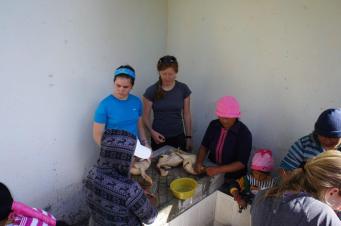 The next morning, dressed in traditional Kichwa clothes, part of the group went to mass with their families while the rest of us stayed behind to bake bread. Five oven-loads later, we piled with our families into two busses, which took us to El Lechero, a sacred tree and prime picnic spot. We set out PBJs, cold-cuts, and fruit and the families once again each brought a dish to combine. One of the community members facilitated this custom, and then offered us a bowl to share. In return, we offered the community free reign of our supplies, resulting in some triple-decker PBJs filled with unspread globs of guanabana jelly. After a group clean-up effort, we continued on to El Parque Condor, a bird rehabilitation center, for a flight demonstration. The kids – and two sixteen year old Traveling School students – got to hold some birds afterwards. Three days later, my brothers were still running around flapping their arms and bird-calling. We returned around 6pm which presented me with my biggest challenge yet: trying to get my homework done while simultaneously entertaining my seven year old brother who loves ninjas, Jackie Chan, and my camera. For the first time since our arrival, I was able to keep my eyes open long enough to finish a journal entry (a feat I was proud of until I realized it was only 7:46pm).